In most competitions the types of tasks that can be set are listed in the event rules. Most events base their rules on chapter 15 of the AX Model Event Rules.
Click on the name of the task for more information and tips from expert competition pilots.
CHAPTER 15 ‑ TASKS
15.1 PILOT DECLARED GOAL (PDG)
15.1.1 Competitors will attempt to achieve a mark close to a goal selected and declared by him before take-off.
15.1.2 Task data:
-
-
-
- method of declaration
- number of goals permitted
- goals available for declarations
- minimum and maximum distances of goal(s) from CLP or ILP as per TDS
- minimum and maximum distances of goal(s) from any goal set by the director
-
-
15.1.3 The result is the distance from the mark to the nearest valid declared goal. Smallest result is best.
____________________
15.2 JUDGE DECLARED GOAL (JDG)
15.2.1 Competitors will attempt to achieve a mark close to a set goal.
15.2.2 Task data:
-
-
-
- position of set goal/target
-
-
15.2.3 The result is the distance from the mark to the target, if displayed, or goal. Smallest result is best.
____________________
15.3 HESITATION WALTZ (HWZ)
15.3.1 Competitors will attempt to achieve a mark close to one of several set goals.
15.3.2 Task data:
-
-
-
- position of various set goals/targets
-
-
15.3.3 The result is the distance from the mark to the nearest target, if displayed, or goal. Smallest result is best.
___________________
15.4 FLY IN (FIN)
15.4.1 Competitors will find their own launch areas and attempt to achieve a mark close to a set goal or target.
15.4.2 Task data:
-
-
-
- position of set goal/target
-
-
15.4.3 The result is the distance from the mark to the target, if displayed, or goal. Smallest result is best.
15.4.4 Only one scoring attempt (marker drop) may be made.
____________________
15.5 FLY ON (FON)
15.5.1 Competitors will attempt to achieve a mark close to a goal selected and declared by them before take-off or during flight.
15.5.2 Task data:
-
-
-
- method of declaration,
- number of goals permitted
- goals available for declarations
- minimum and maximum distance between previous mark and declared goal
- minimum and maximum distance between declaration point and declared goal(s)
- minimum and maximum distances of declared goal(s) from any goal set by the director
-
-
15.5.3 The result is the distance from the mark to the nearest valid declared goal. Smallest result is best.
____________________
15.6 HARE AND HOUNDS (HNH)
15.6.1 Competitors will follow a hare balloon and attempt to achieve a mark close to a target displayed by the hare no more than two meters upwind of the basket after landing.
15.6.2 Task data:
-
-
-
- description of the hare balloon
- intended flight duration of the hare balloon
-
-
15.6.3 The result is the distance from the mark to the target. Smallest result is best.
15.6.4 Variation from intended flight duration of the hare shall not be ground for complaint.
15.6.5 The hare may deflate after landing and may be removed from the field.
15.6.6 The hare may display a banner hanging below his basket. No competitor shall display any banner hanging below the basket during this task.
_______________
15.7 WATERSHIP DOWN (WSD)
15.7.1 Competitors will fly to the launch point of a hare balloon, follow the hare and attempt to achieve a mark close to a target displayed by the hare no more than two meters upwind of the basket after landing.
15.7.2 Task data:
-
-
-
- description of the hare balloon
- location of the launch point of the hare balloon
- set take‑off time of the hare balloon
- intended flight duration of the hare balloon
-
-
15.7.3 The result is the distance from the mark to the target. Smallest result is best.
15.7.4 If the hare balloon does not take off within 5 minutes after the set time then this task is considered cancelled.
15.7.5 Variation from the flight duration of the hare shall not be ground for complaint.
15.7.6 The hare may deflate after landing and may be removed from the field.
15.7.7 The hare may display a banner hanging below his basket. No competitor shall display any banner hanging below the basket during this task.
_________________
15.8 GORDON BENNETT MEMORIAL (GBM)
15.8.1 Competitors will attempt to achieve a mark within a scoring area(s) close to a set goal.
15.8.2 Task data:
-
-
-
- position of goal/target
- description of scoring area(s)
-
-
15.8.3 The result is the distance from the mark to the target, if displayed, or goal. Smallest result is best.
__________________
15.9 CALCULATED RATE OF APPROACH TASK (CRT)
15.9.1 Competitors will attempt to achieve a mark within a valid scoring area close to a set goal. The scoring area(s) will have unique times of validity.
15.9.2 Task data:
-
-
-
- position of goal/target.
- description of scoring area(s) and their validity times
-
-
15.9.3 The result is the distance from the mark to the target, if displayed, or goal. Smallest result is best.
15.9.4 A competitor who does not achieve a mark inside a scoring area during its time of validity, will not achieve a result.
____________________
15.10 RACE TO AN AREA (RTA)
15.10.1 Competitors will attempt to achieve a mark or valid track point, as specified in the task data, in the shortest time within a scoring area(s) or airspace(s).
15.10.2 Task data:
-
-
-
- arrangements of timing
- description of scoring area(s)
-
-
15.10.3 The result is the elapsed time from the take off to the mark or first valid track point. Smallest result is best.
15.10.4 The timing ends at the moment the marker is on the ground as seen by the officials, the electronic mark is dropped or at the moment of the first valid track point in the scoring area, if track points only was set.
____________________
15.11 ELBOW (ELB)
15.11.1 Competitors will attempt to achieve the greatest change of direction in flight.
15.11.2 Task data: (If no markers are used)
-
-
-
- description of track point “A”
- description of track point “B”
- description of track point “C”
-
-
15.11.3 (see section IV events with observers)
15.11.4 The result is 180 degrees minus the angle ABC. Greatest result is best.
___________________
15.12 LAND RUN (LRN)
15.12.1 Competitors will attempt to achieve the greatest area of a triangle “A”, “B” and “C”
15.12.2 Task data:
-
-
-
- location of point “A”
- method of determining point “B”
- method of determining point “C”
- description of scoring area(s)
-
-
15.12.3 The result is the area of triangle ABC. Greatest result is best.
___________________
15.13 MINIMUM DISTANCE (MDT)
15.13.1 Competitors will attempt to achieve a mark or valid track point close to the reference point, after flying a minimum set time or distance.
15.13.2 Task data:
-
-
-
- arrangements of timing
- minimum set time or distance
- reference point
-
-
15.13.3 The result is the distance from the mark or closest valid track point to the reference point. Smallest result is best.
15.13.4 The scoring position is the mark or best track point after the minimum time or distance has elapsed. Otherwise the scoring position will be the landing position, provided that the balloon has been seen by an official to be still airborne after the minimum time.
___________________
15.14 SHORTEST FLIGHT (SFL)
15.14.1 Competitors will attempt to achieve a mark or valid track point close to the reference point within a set scoring area(s).
15.14.2 Task data:
-
-
-
- description of scoring area(s)
- reference point
-
-
15.14.3 The result is the distance from the mark or best valid track point to the reference point. Smallest result is best.
____________________
15.15 MINIMUM DISTANCE DOUBLE DROP (MDD)
15.15.1 Competitors will attempt to achieve two marks or valid track points close together in different scoring areas.
15.15.2 Task data:
-
-
-
- description of scoring areas
-
-
15.15.3 The result is the distance between the marks or track points. Smallest result is best.
15.15.4 Competitors will not achieve a result, unless they have valid track points or marks in different scoring areas as per the TDS.
____________________
15.16 MAXIMUM DISTANCE TIME (XDT)
15.16.1 Competitors will attempt to achieve a mark or valid track point far away from the reference point, within a maximum set time.
15.16.2 Task data:
-
-
-
- maximum set time
- arrangements for timing
- reference point
-
-
15.16.3 The result is the distance from the mark or furthest valid track point to the reference point. Greatest result is best.
15.16.4 (see section IV events with observers)
___________________
15.17 MAXIMUM DISTANCE (XDI)
15.17.1 Competitors will attempt to achieve a mark or valid track point far away from the reference point within a set scoring area(s).
15.17.2 Task data:
-
-
-
- description of scoring area(s)
- reference point
-
-
15.17.3 The result is the distance from the mark or valid track point to the reference point. Greatest result is best.
___________________
15.18 MAXIMUM DISTANCE DOUBLE DROP (XDD)
15.18.1 Competitors will attempt to achieve two marks or valid track points far apart in the scoring area(s).
15.18.2 Task data:
-
-
-
- description of the scoring area(s)
-
-
15.18.3 The result is the distance between the marks or farthest valid track points. Greatest result is best.
____________________
15.19 ANGLE (ANG)
15.19.1 Competitors will attempt to achieve the greatest change of direction from a set direction. The change of direction is the angle between the set direction and line “A-B”.
15.19.2 Task data:
-
-
-
- description of point “A” and “B”
- set direction
- minimum and maximum distances from “A” to “B”
-
-
15.19.3 The result is the angle between the set direction and the line “A-B”. Greatest result is best.
____________________
15.20 3D Shape Task (3DT)
15.20.1 Competitors will attempt to achieve the greatest distance within a set airspace.
15.20.2 Task data:
-
-
-
- description of set airspace(s).
-
-
15.20.3 The result is the accumulated horizontal distance between valid track points in the set airspace(s). Greatest result is best
____________________
15.21 Altitude Profile Task (APT)
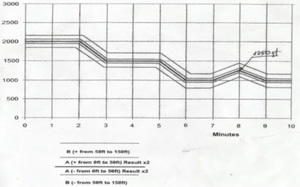
15.21.1 Competitors will attempt to achieve the greatest time within a set airspace. The airspace is defined by one or two bands around a given altitude profile where the time within the inner band counts 2x, the time within the outer band counts 1x and the time outside the outer band does not count. The task will be started with an electronic mark.
15.21.2 Task data:
-
-
-
- description of set airspace(s) (see sketch)
-
-
15.21.3 The result is the accumulated time in the set airspace(s). Greatest result is best.
Example sketch