Competition Ballooning – the Judge Declared Goal
The rule (or information) for this task is set out in Chapter 15 of the Event Rules
This could be regarded as the simplest task and possibly the fairest when trying to judge the skill of flying, as all competitors take off from a common launch area and all are aiming for the same target. The launch period is usually about 30 minutes so the only remaining variable is any change in wind direction between first off and last off. As stated in the rule you will be given the position of the set goal/target on the task sheet at the briefing. The goal is a place defined by grid reference on the competition map, usually a road junction. The target is a prominent cross displayed in the vicinity of the goal (usually in the field adjacent) or at a specified coordinate e.g. 200metres to the north west of the goal. If you are only given the goal reference you head for that and the cross will be close to it. Often you will only be given the coordinates of the target with no associated goal and this will be found in the middle of a field. Whichever, the first thing to do is to draw a line from your take off point to the target (or goal) and find out what direction that route gives. Remember that on a large launch field your take off point may be some distance from the common launch point so you may need to adjust your route once you arrive at the launch site. Referring to the weather information sheet will then give you an idea at what height you will need to fly to take you to the target. The next thing to do is to draw a line back from the target in the direction that the ground wind is coming from; that should give you the direction that you will be finally flying in over the target to drop your marker. The next decision is whether to take off first, in the middle with everybody else or last. There is no correct answer. In Japan when faced with multiple tasks and the winds dropping out altogether after a couple of hours it is always best to take off early. Another advantage of early take off is a fairly unobstructed approach to common targets. However having a few balloons in front will tell you a lot about the wind changes near the ground as they run in to the target and if far enough in front may well allow you to correct in time if there has been any major change. As you take off it is worth noting the wind direction near the surface. You may then amend the ground wind route into the target.
There are different tactics when flying to the target. The aim is to approach the target at a height that you will be able to see it early enough. You should also be in a position where the final descent will allow you to line up with the target near the ground. So if the wind is to the left on the ground then one needs to get to the right of your route so the descent brings you into the ground wind just upwind from the target. If the target is some way away it may allow you to come down somewhere along the route and test out the ground winds again. Should the ground wind have altered, you will have to allow for this change by repositioning your descent. If in the middle of the pack then one also has to take account of surrounding balloons and in one championship I found myself above a balloon on three successive targets as I approached which prevented me from descending into the ground wind I required.
The ground wind may well be different at the target to that experienced at take-off as the height of the ground at the target may be different or it may be sheltered in a valley. The wind in the northern hemisphere should veer with height (i.e. move to the right with height) – but not always. The left on the ground will tend to go during a flight in the morning and will tend to increase during an evening flight. Vital information on ground winds at the target can be given by your crew if they get there in time. Methods used by your ground crew can be a balloon on a string or setting off several free piballs feeding the information on direction back to you by radio. Smoke may give you a clue as well but remember that you may only see the first 50ft of the smoke column before it disperses and that will be at a height that your envelope will not get down to – hopefully! Wind information may include trends and whether there is any gusting. Though one tries to fly low over the target to drop the marker, if gusting is occurring as the land warms on a morning flight then it may be best to elect to use the wind just above the ground gusting layer which may have a more constant direction though you will have to drop your marker from height.
That leaves dropping the maker. Dropping, or throwing markers if allowed, can only be perfected with practice. Task data will tell you whether you can throw the marker or you have to use the gravity marker release method (where the marker has to drop from the edge of the basket). For gravity marker release you need to get your balloon over the target whereas when you are throwing it is often best to pass the target just to one side as you have a better idea of height above the target. Once you have dropped your marker you have to clear the target area so as not to obstruct others as they approach.
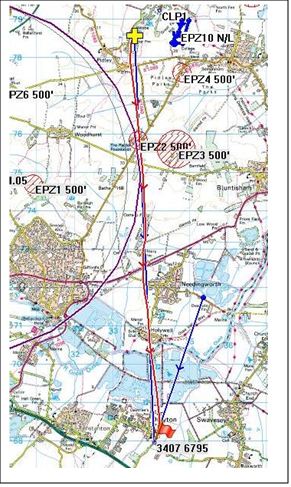
A JDG from Pidley, Cambridgeshire

A JDG at the European Championships 2007
 A difficult target on a downwind slope at the Mobilux Trophy, Luxembourg
Written by David Bareford
